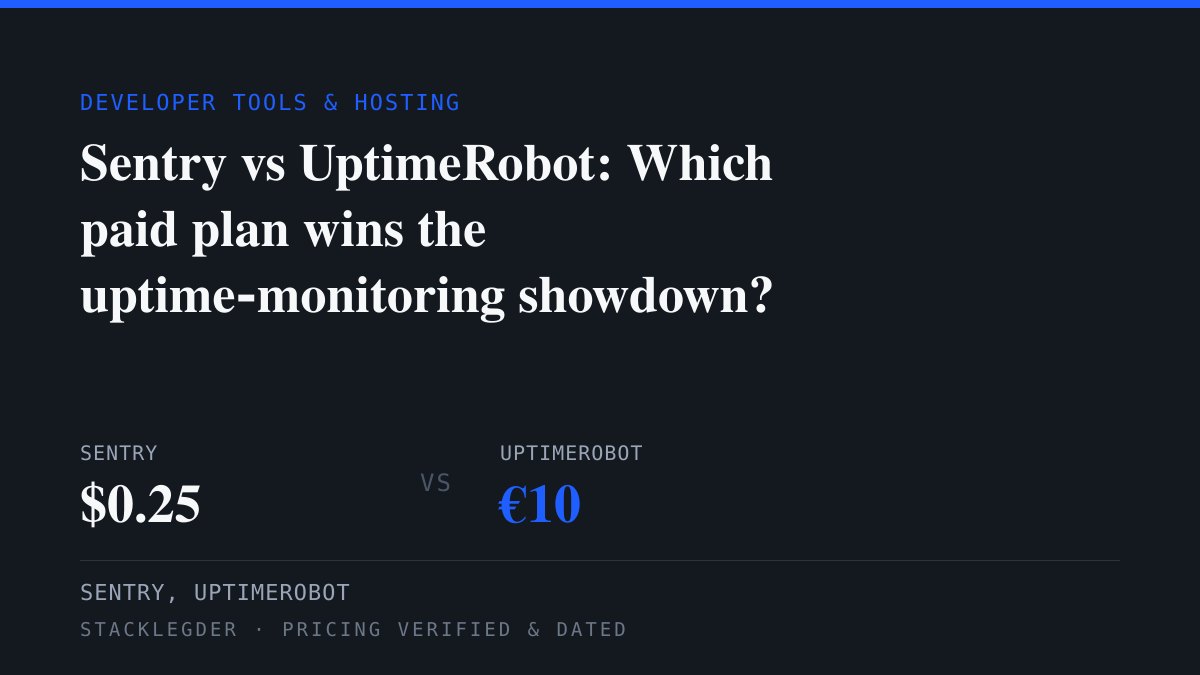
The moment you need to move beyond a free ping, the price tags start to bite: Sentry’s Uptime Monitoring costs $1/month for a single monitor, while UptimeRobot’s entry‑level Solo plan asks for EUR 10/month and throws in a 60‑second interval plus SSL and DNS checks.
What you actually pay for each monitor
Both services bundle monitoring with a suite of extras, but the composition differs. Sentry’s $1/month line item is a stand‑alone uptime monitor that sits alongside its broader observability stack; you still need to subscribe to a base Sentry tier for logs, profiling, or other features, each priced separately (Logs $0.5, UI Profiling $0.25, Continuous Profiling $0.03, Cron Monitoring $0.78). In contrast, UptimeRobot’s Solo plan at EUR 10/month delivers a 60‑second monitoring interval, all monitor types, SSL and DNS checks, and even three status pages on your own domain—all bundled under a single price.
How the pricing scales with team needs
If your team grows, Sentry forces you into the team tier at $26/month, which includes unlimited users and a handful of custom dashboards, then the business tier at $80/month for advanced quota management and SAML + SCIM support. Those tiers are independent of the per‑monitor costs, so a company that already pays $26/month for Sentry’s core observability will add $1 per monitor on top. UptimeRobot, however, offers a Team tier at EUR 41/month that bumps the interval down to 30 seconds, adds three seats, and expands status‑page capacity to 100 with white‑labeling. The Scale tier at EUR 77/month pushes the interval to 15 seconds and includes either 200 or 500 monitors plus five seats. Those higher tiers bundle the monitor count into the plan price, removing the need for per‑monitor add‑ons.
| Plan | Vendor | Price | Includes |
|---|---|---|---|
| Uptime Monitoring | Sentry | $1/month | 1 uptime monitor, custom options |
| Solo | UptimeRobot | EUR 10/month | 60‑second interval, all monitor types, SSL & DNS, 3 status pages, own domain |
| Team | UptimeRobot | EUR 41/month | 30‑second interval, 3 seats, 100 status pages, white‑label |
| Scale | UptimeRobot | EUR 77/month | 15‑second interval, 200 or 500 monitors, 5 seats |
For a solo developer who only needs a single ping, Sentry’s $1/month is the cheapest absolute number, but you still have to be on a Sentry plan that may already cost $26/month. UptimeRobot’s Solo plan at EUR 10/month is a higher headline figure but includes a full monitoring suite without requiring a separate base subscription. Larger teams that care about faster intervals and branding will find UptimeRobot’s Team and Scale tiers more predictable, while organizations already entrenched in Sentry’s error‑tracking ecosystem might prefer to tack on the $1 monitor to their existing $26 or $80 plan.
In practice, the decision hinges on whether you already pay for Sentry’s broader observability stack. If you do, the extra $1 per monitor is negligible and keeps everything in one dashboard. If you’re starting from scratch, UptimeRobot’s all‑in‑one Solo tier gives you more bang for the buck and avoids the hidden cost of a separate Sentry subscription. Choose Sentry if you need deep integration with logs, profiling, and error tracking; choose UptimeRobot if you want a straightforward, feature‑rich uptime service without extra layers.
Pricing verified on 2026-09-19.