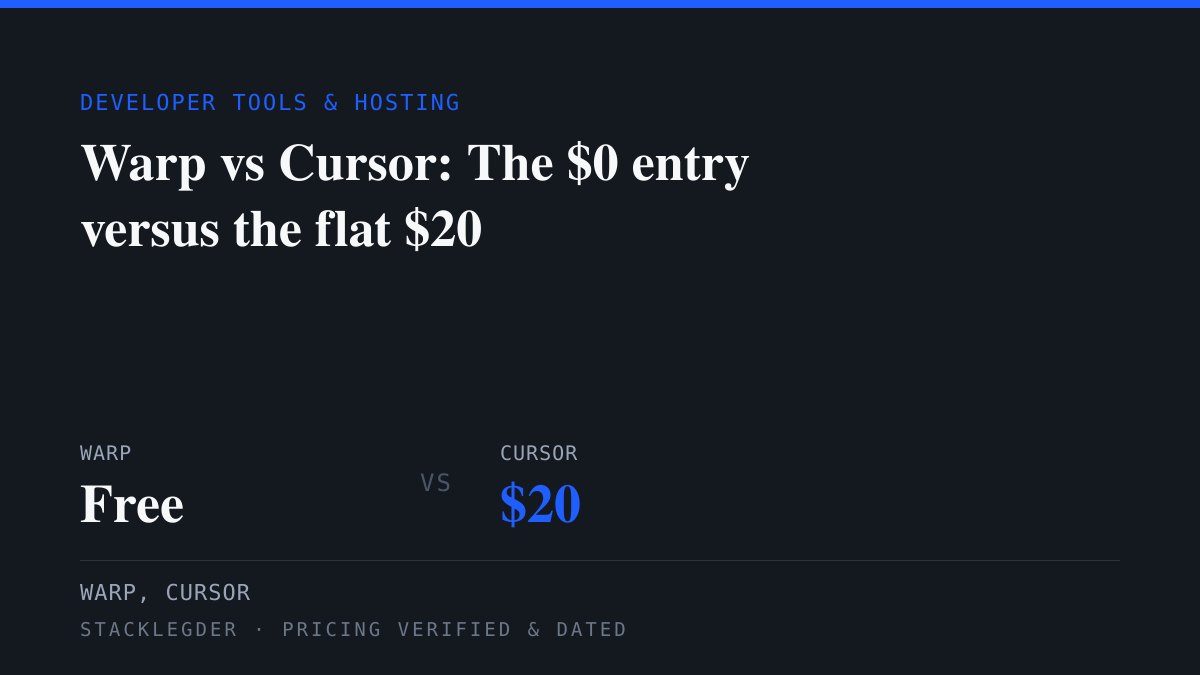
Warp gives you a free tier at $0/month, while Cursor’s entry point is a flat $20 for Pro. That gap defines the entire comparison: one vendor invites you to start for nothing and scale into per-account fees, the other asks for an immediate, fixed commitment regardless of how deeply you use the AI. It is a choice between a low-friction on-ramp and a predictable, albeit non-zero, baseline.
The per-account ladder versus the flat list
| Vendor | Plan | Price | Billing Unit |
|---|---|---|---|
| Warp | Free | $0/month | /month |
| Warp | Build | $20/month | /month |
| Warp | Max | $200/month | /month |
| Warp | Business | $50/month per user | /user /month |
| Warp (discounted) | Build | $18/month | /month |
| Warp (discounted) | Max | $180/month | /month |
| Warp (discounted) | Business | $45/month per user | /user /month |
| Cursor | Pro | $20 | flat |
| Cursor | Pro+ | $60 | flat |
| Cursor | Ultra | $200 | flat |
| Cursor | Teams | $40 | flat |
Warp’s structure is explicitly tied to usage and team size. The Free plan is $0/month, a genuine zero-cost entry point that Cursor does not offer. Moving to Build at $20/month or Max at $200/month keeps the billing unit as a single account, described as pay-as-you-go starting at those rates. For teams, the Business plan shifts to a per-user model at $50/month per user, with a discounted list showing $45/month per user, capped at 25 seats. This creates a clear escalation path where cost is directly linked to how many people are using the tool and how much AI capacity they consume.
Cursor, conversely, presents a static menu of flat fees. Pro is $20, Pro+ is $60, and Ultra is $200. There is no per-seat language in the provided pricing data; these appear as single figures. The Teams plan is listed at $40, which is notably cheaper than Warp’s per-user Business rate, but without explicit per-seat qualifiers in the source data, the scaling mechanics for larger groups are less transparent than Warp’s explicit per-user pricing.
The tension here is between the flexibility of Warp’s tiered, usage-aware model and the simplicity of Cursor’s flat list. Warp’s free tier is a significant advantage for individuals who want to experiment without financial risk, and its per-user Business pricing offers clarity for teams that need to budget for specific headcount. Cursor’s flat rates are easier to grasp at a glance, with Pro matching Warp’s Build price at $20, but the lack of a free tier and per-seat transparency can make long-term budgeting less precise for growing organizations. If you are a solo developer or a small team that values the ability to start for free and scale predictably per user, Warp’s structure aligns with that workflow. If you prefer a simple, flat fee without the complexity of per-user calculations and are willing to pay $20 upfront for Pro access, Cursor offers a more straightforward, if less flexible, entry point. The choice ultimately rests on whether you prioritize the zero-cost on-ramp and granular team pricing of Warp, or the clean, flat-rate simplicity of Cursor.
Pricing verified on 2026-09-13.