
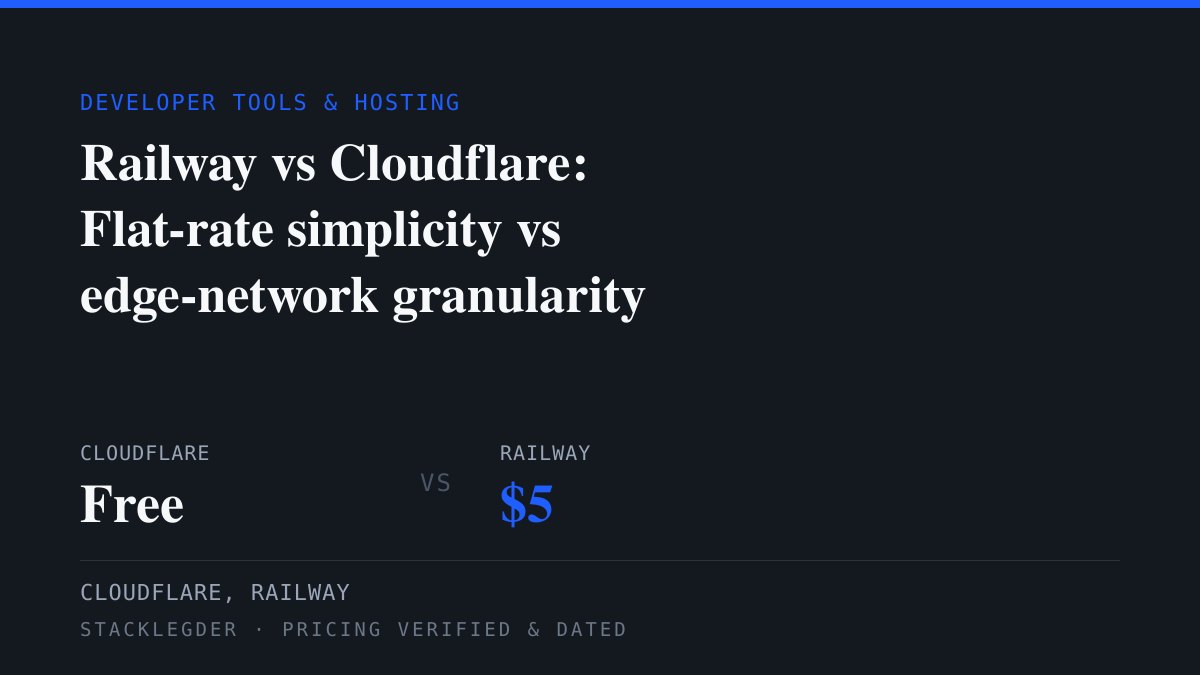
Railway’s Hobby plan costs $5, while Cloudflare’s Free tier is $0. That is the entire difference between a platform that wants to host your whole app and one that wants to be the invisible infrastructure layer beneath it. One is a bill for a service; the other is a menu of components.
The flat-fee logic of a single invoice
Railway does not play the usage-game. The Hobby plan is $5 per month with included usage, and the Pro plan is $20 per month for teams shipping to production. There are no per-seat add-ons, no surprise overage fees for requests, and no need to model your traffic to predict next month’s invoice. For a solo developer or a small team, this is the most frictionless way to deploy a full-stack application. You pay $5, you ship, and the math ends there. The Pro tier at $20 is similarly blunt: it is a flat fee for production workloads, not a base rate that balloons with every API call. If your primary concern is knowing exactly what you will pay before you hit deploy, Railway’s structure is the only one in this comparison that delivers that certainty without requiring you to become a cloud-cost accountant.
The component-based reality of edge infrastructure
Cloudflare’s pricing is not a single number; it is a stack. The Free tier at $0 per month covers personal or hobby projects that aren't business-critical. Step up to Pro at $20 per month for professional websites, or Business at $200 per month for small businesses operating online. But the real complexity lies in the pay-as-you-go and component rates. You can pay $7 per user per month for teams over 50 solving narrow SSE use cases. For compute, Workers cost $0.3 per request, Durable Objects $0.15 per request, Browser Rendering $0.09 per browser hour, and R2 storage $0.01 per unit. These are not plan prices; they are unit costs. If you run a high-traffic edge workload, these numbers add up fast and require active monitoring. The flexibility is immense—you only pay for what you use—but the predictability is nonexistent. A spike in traffic can turn a modest budget into a line item that dwarfs Railway’s entire Pro plan in a single day.
| Vendor | Plan | Price |
|---|---|---|
| Railway | Hobby | $5 |
| Railway | Pro | $20 |
| Cloudflare | Free | $0 |
| Cloudflare | Pro | $20 |
| Cloudflare | Business | $200 |
| Cloudflare | Pay-as-you-go | $7 per user |
| Cloudflare | Workers | $0.3 |
| Cloudflare | Durable Objects | $0.15 |
| Cloudflare | Browser Rendering | $0.09 |
| Cloudflare | R2 | $0.01 |
Railway is the pick for flat-budget solo developers who want a single, predictable invoice for hosting their entire stack. Cloudflare is the pick for edge-heavy enterprise teams that need granular control over serverless functions, stateful coordination, and global storage, and who have the engineering bandwidth to manage usage-based costs. If you are not already deep in the Cloudflare ecosystem, the complexity of its component pricing is a significant hurdle. If you are, the flexibility is worth the vigilance.
Pricing verified on 2026-09-19.