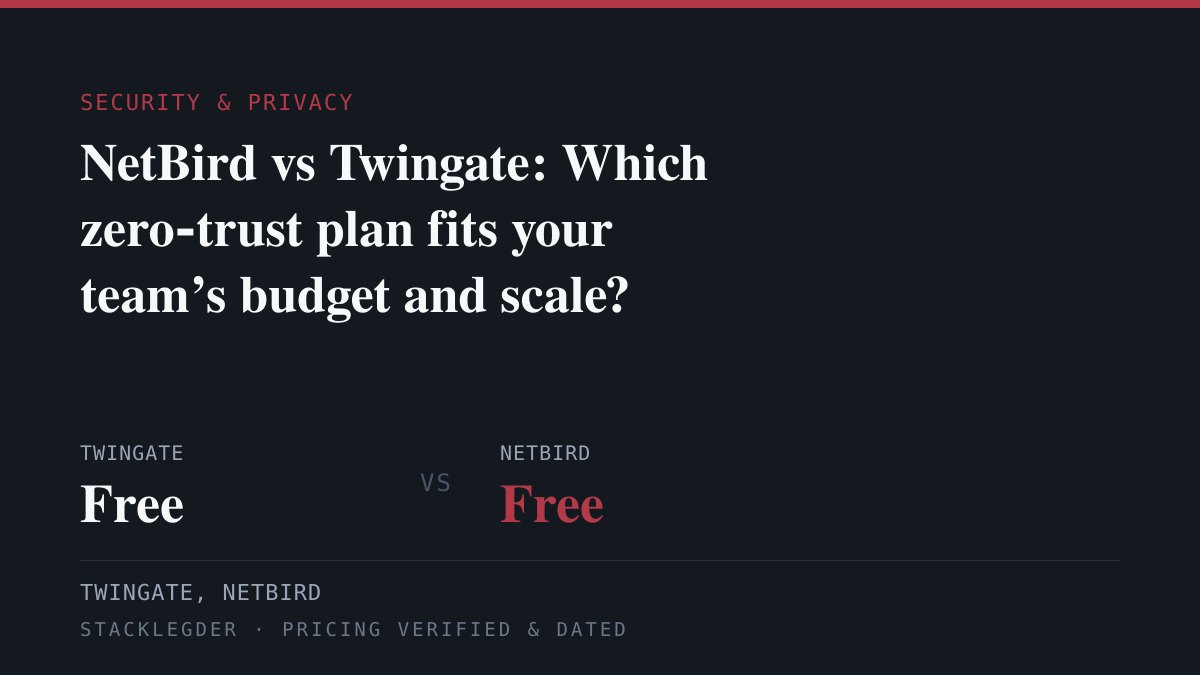
When a growing team outgrows a free zero‑trust tier, the first thing they notice is the jump from $0 or EUR 0 to a paid per‑seat price. That jump looks very different on Twingate’s page – a $5‑monthly charge for a Teams seat on an annual contract – versus NetBird’s flat EUR 6 per user for its Team tier. The contrast in currency and the way each vendor caps users changes the calculus for every buyer.
How the plans break down
Twingate structures its paid tiers around user caps. The Teams tier costs $5/month per user when billed annually and $6/month per user on a month‑to‑month basis, and it tops out at 100 users. The Business tier steps up to $10/month per user annually or $12/month per user monthly, with a maximum of 500 users. Both tiers sit alongside a niche Home plan at $15/month for up to seven users, which adds secure service accounts and exit networks but has no direct NetBird counterpart.
NetBird, by contrast, removes user caps entirely. Its Team tier is EUR 6/month per user and its Business tier is EUR 12/month per user; both tiers allow unlimited users while still adding 10 machines per user on top of a base allowance of 100 machines. The free tier on NetBird mirrors Twingate’s – EUR 0/month for up to five users – but also grants a 100‑machine limit, a detail that can bite small teams with many devices.
The practical impact of currency and caps
Because Twingate lists prices in USD, U.S. buyers see a straightforward dollar figure and can compare annual versus monthly costs directly. NetBird’s page serves EUR, which the site notes is region‑priced; a U.S. buyer must translate EUR 6 or EUR 12 into dollars, adding a layer of budgeting uncertainty. The unlimited‑user model on NetBird can be a decisive advantage for organizations that expect rapid headcount growth, while Twingate’s caps may suit firms that prefer tighter licensing controls or that need built‑in SSO integrations – the Teams and Business tiers include [[Google](/entry/yubikey-vs-google-titan-vs-solokeys-what-hardware-2fa-actually-costs) Workspace](/entry/proton-mail-vs-fastmail-vs-google-workspace-for-a-small-business-2026) or [Okta](/entry/jumpcloud-vs-okta-vs-rippling-smb-identity-and-device-priced) provisioning out of the box.
| Provider | Free tier | Entry paid tier | Top paid tier | User cap (paid) | Currency |
|---|---|---|---|---|---|
| Twingate | $0/mo, 5 users | $5/mo per user (annual) / $6/mo per user (monthly) | $10/mo per user (annual) / $12/mo per user (monthly) | 500 | USD |
| NetBird | EUR 0/mo, 5 users, 100 machines | EUR 6/mo per user | EUR 12/mo per user | Unlimited | EUR |
For a small team that values integrated SSO and is comfortable with a 500‑user ceiling, Twingate’s Business plan offers a predictable dollar price and a clear feature set. If your organization anticipates scaling beyond that ceiling, or if you prefer a single per‑seat price without worrying about user limits, NetBird’s unlimited model becomes attractive – provided you’re okay with handling the euro pricing conversion. In the end, the choice hinges on whether you prioritize currency simplicity and built‑in SSO (Twingate) or unlimited scalability and a flat euro rate (NetBird).
Pricing verified on 2026-09-13.